

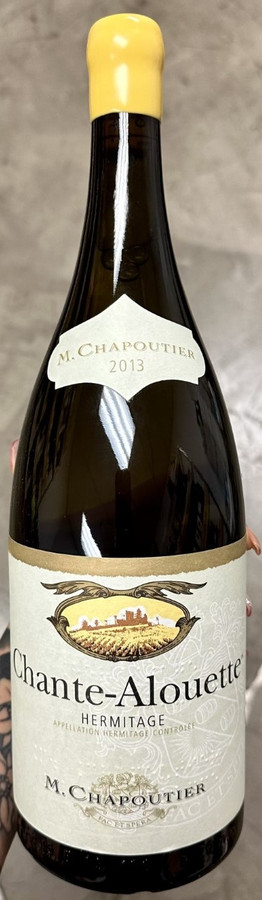
Winemaker Notes
Tasting notes
Appearance: brilliant and green gold.
Nose: complex and subtle, aromas of quince, walnut, honey, ginger, acacia with a hint of linden-tree.
Palate: frank attack, without aggressiveness, final of almond, very elegant and good length.
Sommelier's advice: Foie gras Crayfish,lobster,Fish. poultry in sauces,white meats Goat's cheese,blue cheese Spicy dishes and curry
Grape variety/varieties: Marsanne.
Harvest: Hand-harvested at maturity.
Soil: The grapes from which this wine is produced come from three different vineyards:
• “Le Méal”: characterized by a soil of very old fluvio-glacial alluvial deposits with a high pebble content.
• “Les Murets”: whose soil is clay-gravel. Its red clays give the wines a full, rich character.
• “Chante-Alouette”: a high-lying terroir whose soil is a mixture of loess and very finely decomposed granite. It gives the wine freshness, salinity and acidity.
• “Le Méal”: characterized by a soil of very old fluvio-glacial alluvial deposits with a high pebble content.
• “Les Murets”: whose soil is clay-gravel. Its red clays give the wines a full, rich character.
• “Chante-Alouette”: a high-lying terroir whose soil is a mixture of loess and very finely decomposed granite. It gives the wine freshness, salinity and acidity.
Vinification: The musts are obtained after a long pressing and are lightly settled before fermentation. Part of the fermentation is carried out in stainless steel tanks and part in demi-muids. The lees are stirred up (bâtonnage) for the first 2-3 months adding texture to the wine.
